Showing posts with label 耳付花器. Show all posts

Wednesday, January 30, 2013

Two Vases/ 二口の花瓶

(日本語は写真の下です。)
These are two vases wood fired at Roger san's studio. The glaze I used was Shino. Although both are made with the same clay body and glaze, results were surprisingly different. One vase has a traditional shino white on one side and orange sheen over soft white on the other. The other vase has what Roger san called "crystals" over pale blue/green and the other side has orange sheen on pale blue/green.
I can not tell how those "crystals" formed, it must be some of those fluke "yohhen" (窯変) that I heard about. Roger san quickly explained to me that the piece was close to the front of the kiln and this must have happened in the cooling process. All I have to say about this is I am pretty happy with the results. Mako at Togei Kyoshitsu told me the kiln god was good to me because I waited a long year to actually make it to do the wood firing at Roger san's. Thank you, kiln god! Both of the vases are sent to Japan to my parents for their 70th birthday. Congratulations for the 70th birthday, Mom and Dad!

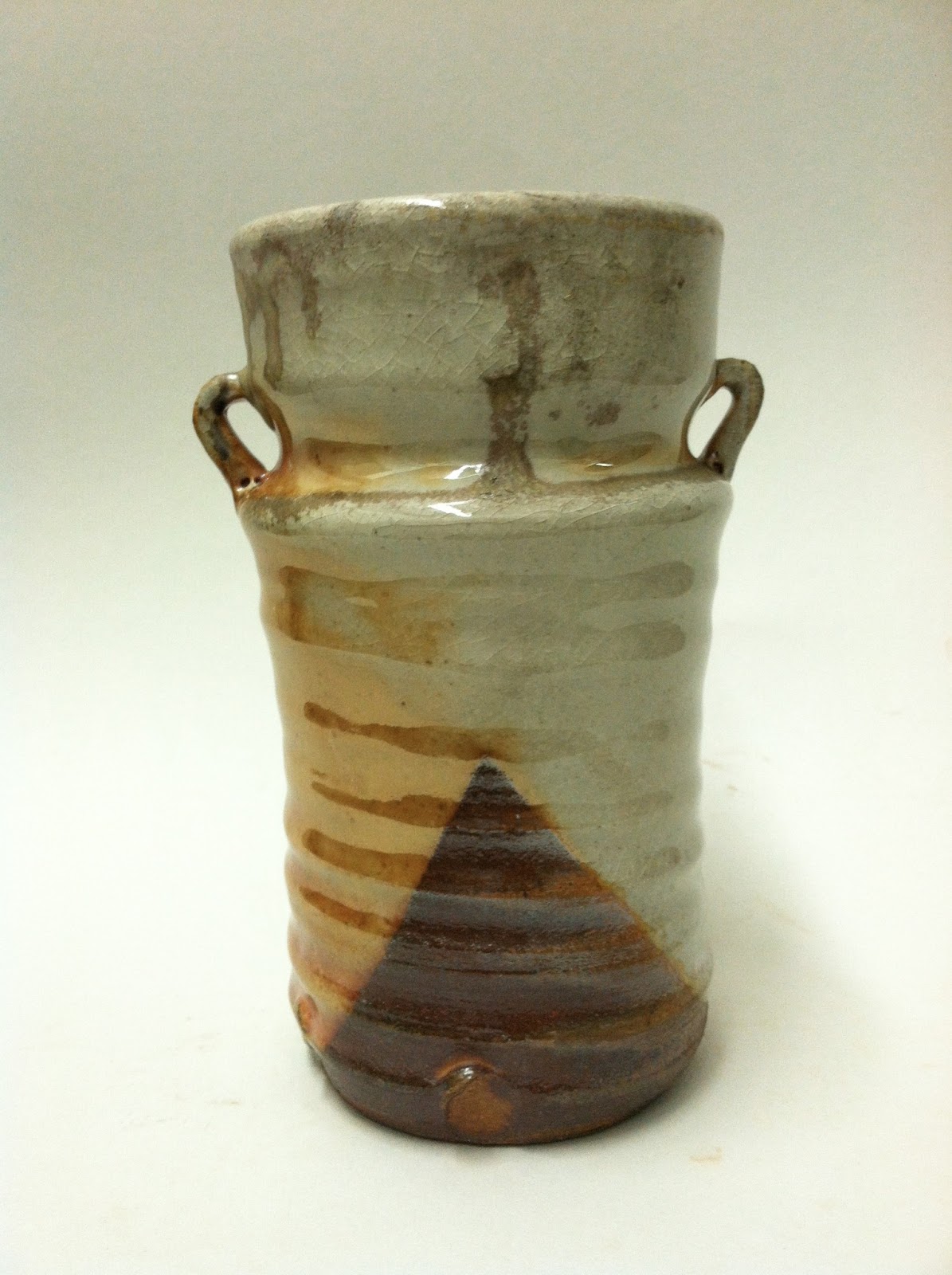


じゃじゃ〜ん!ロジャーさんの所で焼いてもらった二口の花瓶です。釉薬は志野を使いました。土も釉薬も同じはずなのにこんなに結果が違くなりました。驚きです。一つは伝統的な志野焼の落ち着いた白の上にオレンジの輝きが見られます。もう一つは今までに見た事のない模様が現れました。ロジャーさんはこれを”クリスタル”と呼んでいました。窯変によって白のはずの志野が薄青/緑になり、その上に金に近いような斑模様。窯変とはうまく云ったものです。どのような仕組みでこうなるのか僕には見当がつきません。ロジャーさんは窯のロストルの近くにあったので、それと相まって冷える過程でこういう窯変が出来るのではと説明してくれました。とにかく僕はこの偶然に感謝しています。陶芸教室のマコさんは、なんだかんだ有って一年も僕はロジャーさんの所に行けずじまいでいたので、窯の神様が僕に良くしてくれたのではと、言ってくれました。窯の神様、ありがとうございます! なお、これらの花瓶は僕の両親の所に七十歳の誕生日を祝して日本に送られました。お父さん、お母さん誕生日おめでとう!

Monday, December 17, 2012

Wood Fired Pots at Roger-san's ロジャーさんの所の薪窯

When someone starts making pottery, sooner or later one wants to try wood firing. I started making ceramic art as a student back in 1996. I made my own raku kiln. When I went back to Japan in 1999, I even built an experimental kiln using kiln shelves to imitate wood firing with my friend Kohtaro Ito.  We packed the kiln with vases and mangrove charcoal, and fired it for several hours. As a matter of fact, we were able to get similar effect to wood firing. We planed to built a a type of real wood firing kiln called "Anagama." The city, however, did not grant us the permission to build the kiln. After that, I went to a grad school for art program back in the U.S. Since then, I never really had a chance to put my own work in the wood firing kiln.
---time warp---
Last year in 2011, I started coming to this wonderful ceramic/pottery studio in NYC called Togei Kyoshitsu of NY. I heard much nice things about wood firing at Roger-san's. But not for me! I had to pass 4 chances to bring my work at Roger-san's because something always came up. After a year, I was finally able to go to Roger-san's!!
The process was pretty simple; we bring our pots to his studio. Glaze if wanted. Put "dango" (I am not sure what we call these balls in English) at any side of the pot so it would not stick to the self.
And leave them. Wait for two weeks. And go pick them up! This must be the easiest wood firing participation there is in this world. Or at least, it must be as easy as making a cup ramen. Thank you for making this so easy for us, Roger-san!
some of my pieces minus the pretty piece with a lid

from left, Rie-san, Yujiro-san, and Tomoe-san of Togei Kyoshitsu  (ひだりから、陶芸教室のりえさん、ユージローさん、トモエさん)
(りえさん、トモエさん、いつもおいしいお食事ありがとうございます!ユージローさん、いつも運転ありがとうございます!)

From right, Aki-chan, Roger-san, and me. (右からアキちゃん、ロジャーさん、僕)

Those pieces did not require sanding or grinding at the bottom. (バリを取らずにすんだ僕の作品) 
As a big fan of Ko Iga flower vases, this became a priceless experience to me. I am already planing on making new pieces for the next visit.

Next time, I will introduce Roger-san and other people's work as well.

陶芸を始めたら誰でも一度はやってみたいのが薪窯を使って自分の作品を焼くこと。1996年に陶土を使ってオブジェを大学で造り始め、ラク窯も自分で作った。1999年には僕の友達の宇都宮陶芸倶楽部の伊東功太郎と一緒に薪窯まがいを窯板を合わせて作り、マングローブ炭を使って焼き、それなりの結果もでた。その夏僕たちは陶芸倶楽部に穴窯を建てる予定ではあったものの、市からは許可が下りず、結局僕はアメリカにM.F.A.を取りに帰り、それからは薪窯で云々と言う話しは全くなかった。
タイムワープ
去年2011年に久しぶりに陶芸を始めた。僕が作陶に励むのはニューヨーク陶芸教室と言う所で、とっても良い所です。いき始めてすぐに、ロジャーさんの所で薪窯をやっていると聞き始めましたが、その後一年は僕には縁のない事になってしまいました。いくチャンスがあるごとに他の何かが持ち上がり、プランはペチャンになったのです。然し今回ついに僕はあのあこがれの薪窯に初挑戦できる事になったーっ!
プロセスはとっても簡単でした。はず自分たちの作品をロジャーさんの所に持っていく。釉薬をかける。団子を的確に付ける。作品を置いていく。二週間待ったら取りにいく。
なんて簡単なんだー!これではカップラーメン作るのと同じくらい簡単。ロジャーさんありがとう!
古伊賀花入れの大ファンである僕にとって今回の経験はとっても計り知れないものになりました。次の機会持っていく持っていく作品のデザインも、もうすっかり始めました。
次回は、ロジャーさんと他の人々の作品も紹介させていただきます。


Thursday, November 29, 2012

Flower Arrangement by Maysoun

My wife, Maysoun, is a public health researcher, however, she also has a passion for flower arrangement. Once in a while, she does flower arrangement for weddings and other occasions. Today, she asked me if she could take the dust collecting vases I made so she can put some flowers in them for her work reception. I was curious to see what she would do with the vases because I made those vessels with tea ceremony in mind.
The shape comes from ancient Iga ware or "Ko Iga Yaki," (古伊賀焼). If there are undeniably Japanese potteries, this is one of them. Ancient Iga ware were produced in Azuchi Momoyama piriod in the mid 16th century, among which were flower vases with small handles or ears on the sides. With the special demand to be used specifically in tea ceremony fitting the taste of "Wabi Sabi," ornamental aspects of the flower vase were made minimal.  Those vessels were wood fired without glaze, hence, ash of the wood melted on the surface of the vases and created unintentional scenery or "Keshiki," (景色). The transformation that happens in the kiln is called "Youhen," (窯変). Because there are very little ways to manipulate what happens on the surface of pots in wood firing kiln, one has to take a chance for the end product. However, wood firing never cease to amaze and fascinate many ceramicist. One drawback with wood firing is that it can only be done as a rare occasion. Unlike gas or electric kiln, potters has to wait for firing wood to accumulate, and everything else that entails wood firing takes time and extra effort. While I had no access to wood firing back in 1999 when I originally started making this vase shape of ancient Iga style, I simply combined the ancient Iga shape and the glaze I liked, Hagi (萩) white. Since then, this shape had been my favorite to throw on the wheel. I have a theory of how the shape of ancient Iga flower vases came about, but I will wait for a different entry for that theory.
In any case, I was pleased to see Maysoun's flower arrangement. The white of the glaze, Shirayuki (白雪): it was made at Togei Kyoshitsu of New York, accentuated every colors there were in the arrangement. The mood of the room went really well with the vase and the arrangement. I would say it was a success arrangement!